
Complete Injection Molding Technology
Injection molding is a fast and efficient manufacturing process used to create plastic parts in large quantities. It works by melting plastic, injecting it into a mold, and forming precise shapes with high accuracy. This course provides a clear, beginner-friendly introduction to injection molding technology, its process, and its real-world applications.
-
 Skill Pathshala Team
 - 0 enrolled students
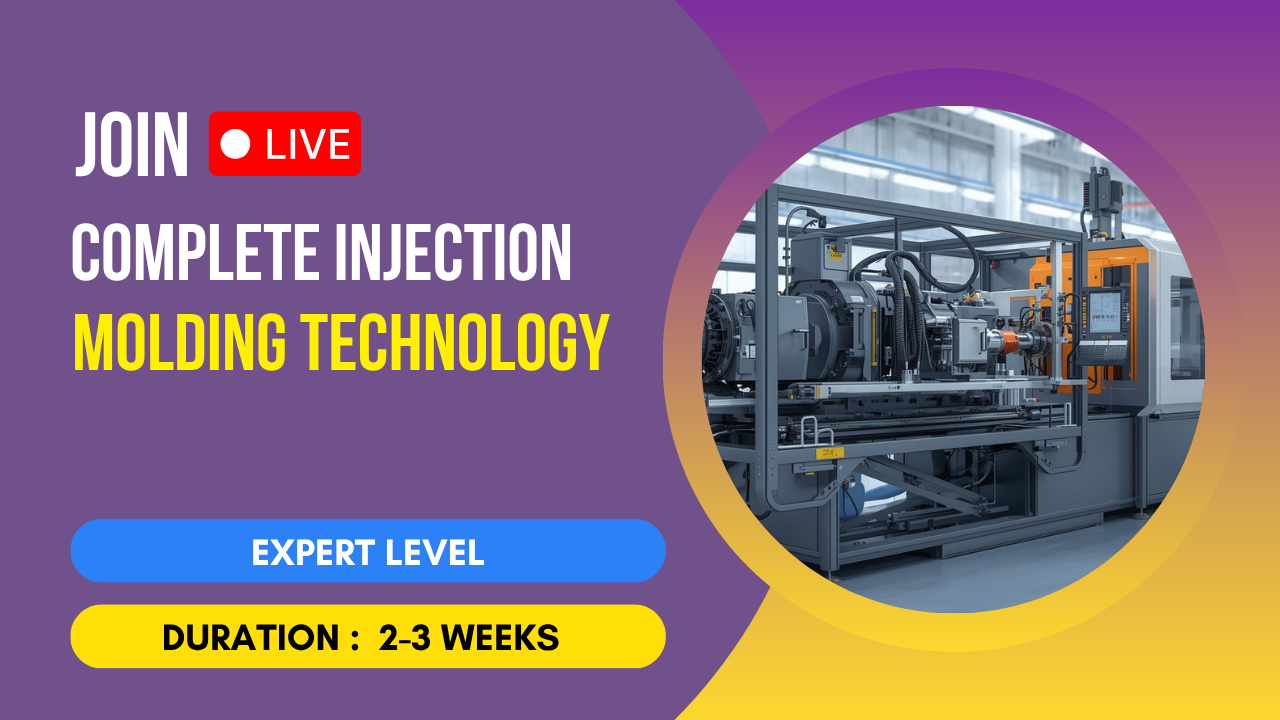
Course Description
Injection molding is one of the most common and efficient manufacturing methods for producing plastic components at scale. In this process, plastic pellets or granules are heated until they melt inside a barrel. The molten plastic is then injected into a mold cavity under high pressure. Once it cools and solidifies, the mold opens and the finished part is released.
This technique is used to create a vast range of plastic products—from tiny precision components to large automotive parts. Injection molding offers high accuracy, excellent repeatability, and the ability to produce complex shapes with fine details. Because of its speed and versatility, it is ideal for large-volume production.
In this course, you’ll gain a complete understanding of injection molding technology—from the basics to advanced concepts—so you can confidently apply it in real-world manufacturing.
What you'll learn in this course
-
The basics of injection molding and how the process works
-
Key components of an injection molding machine
-
Types of plastics used for molding and their properties
-
How molds are designed and how parts are formed
-
Common defects in molded parts and how to fix them
-
Industrial applications and real-world use cases
-
Step-by-step understanding of the complete production workflow
Requirements
-
No prior experience in manufacturing or plastics needed
-
Basic understanding of science concepts (helpful but not mandatory)
-
Interest in learning how plastic products are made
-
A device with internet access to follow lessons and demonstrations
Curriculum
- 10 Lessons
- 900 mins.
- Understanding the injection molding process from raw material to finished product
- Advantages and limitations of injection molding in modern manufacturing
- Types of products made through injection molding
- Overview of the injection molding workflow and industry applications
- Types of plastics: thermoplastics, thermosets, and elastomers
- Properties of common molding materials (ABS, PP, PE, PVC, Nylon, etc.)
- Material selection based on strength, flexibility, heat resistance, and cost
- Additives, colorants, and fillers used to enhance material performance
- Main parts of an injection molding machine and their functions
- Working mechanism of the hopper, barrel, screw, and nozzle
- Clamping unit, injection unit, and auxiliary equipment explained simply
- Automation and robotics used in modern molding machines
- Types of molds: two-plate, three-plate, hot runner, cold runner
- Mold components: core, cavity, runners, gates, vents, ejector systems
- Basics of draft angles, wall thickness, undercuts, and parting lines
- How mold design affects product quality and production cost
- Step-by-step explanation of filling, packing, cooling, and ejection
- Importance of temperature, pressure, and time control
- Understanding cycle optimization to improve efficiency
- How process parameters influence product appearance and strength
- Identifying defects like sink marks, flash, warping, weld lines, and short shots
- Root causes of defects explained in simple terms
- Practical troubleshooting techniques used in factories
- Preventive measures to improve consistency and product quality
- Inspection methods for dimensions, strength, and visual quality
- Tools and instruments used for quality testing
- Setting quality standards for mass production
- Documentation, reporting, and continuous improvement practices
- Multi-material and overmolding techniques
- Gas-assisted, micro-molding, and thin-wall molding
- Using simulation software for mold flow analysis
- Energy-efficient and sustainable molding practices
- Preparing raw materials and machine setup
- Safety procedures and industrial best practices
- Production planning, cycle time calculation, and cost estimation
- Handling maintenance, cleaning, and machine troubleshooting
- Case studies from automotive, medical, electronics, and consumer goods sectors
- How companies scale injection molding for mass production
- Trends in automation, AI, and smart manufacturing
- Career paths and business opportunities in injection molding
Your Instructor
Skill Pathshala Team
Advanced Educator
Skill Pathshala is an online learning community with thousands of classes for creative and curious people, on topics including illustration, design, programming, photography, video, freelancing, and more. On Skill Pathshala, members come together to find inspiration and take the next step in their creative journey.
- Duration span 900 mins.
- Lectures0
- LanguageHindi
- Skill levelExpert
Secure Payment:
